Monday, July 28, 2014

I’m Stronger Than MOMA Baby

Zero #9 - Ales Kot (w) / Tonci Zonjic (a) / Jordie Bellaire (c)


(1) Covers
The cover of Zero #9 is simple. The same building repeated twice. In its first iteration it is pristine and new. Although resembling something out of the soviet block, one wouldn’t scoff when passing by on their way home. In the second incarnation though it is crumbling and uninhabitable.Torn apart by war and violence. 

The overarching narrative of Zero has always been the subversion of the James Bond model. The spy whose job never wears on him, the new building. By issue nine though we have seen Zero’s facade crack. His walls are crumbling. He is a pawn in a game that he is desperately trying to break free from as it kills and maims everyone around him. 

The back cover repeats these images once again, although this time they are in worse shape. While it may relate more explicitly to the final pages of this story, it feels more like a sign of things to come. A building bombed to ash. A man who's life is falling apart around him. The man who never felt his mothers touch, just her sacrifice. Intended or not.
(2) hype and war

This issue is one of the rare examples of hype increasing the reading experience. Hype, in almost every other case i have come across, generally leads to an odd bitterness within me; a  “i don’t get what all that hubub was about". This issue though left me filled with dread as each page turn piled on top of each other. Something had to happen to cause this talk. And while there were false leads, like when the warlord insisted a soldier play a video tape, which immediately made me hope Kot hadn’t watched Sabotage recently, because my heart couldn’t take that as an outcome...

It didn’t end that way though. Instead it concluded in something equally as terrible. As terrible as anything you could imagine. Because in war that is what happens, the worst things that you can think of are birthed into reality.  

The ending is the ending though, and as horrific as it is on its own it also reverberates across the series, like every issue of Zero. Their is an echo of atrocities that lead to the man named Zero, that even his birth and death doesn't seem to have escaped. 
 

(3) the way the tea leaves blow


Zonjic’s artwork has a quietness to it. When he depicts the country of Bosnia, and the people that live there, their is a veneer to the surface. As everything around them crumbles or burns to the ground, there remains a resolve to their persons. A feeling that everything is going to be okay, until it’s not. When a soldier points the assault rifle he’d recently purchased from Zizek at him his body language imparts a feeling of calm, that everything is in control, but underlining that calm is that it is his to control. Exclusively.

In a scene midway through the issue Zizek and a warlord are sitting in front of a home in a desolate area outside of town, drinking tea. The page consists of four horizontal panels. Two solely of the warlord, one of Zizek and one of the two of them. The Warlord asks Zizek a question in the first panel and contemplates his answer in the third. These two panels are nearly identical, for a moment they seem like straight copy and pastes, but there are changes, changes that unveil the pairs power dynamic more than words ever could.

When the warlord asks Zizek if he is selling arms to a competitor the steam from his cup of tea is blowing outwards, towards the destruction of the town in front of them, almost pointing directly at what he has done, and is capable of. After Zizek’s lie though, as the Warlord moves his arm towards the destruction of the town, the steam flow is pushed back towards him, almost as if he is inhaling the carnage back into himself. The color shifts to a shadow as a cloud seemingly passes over head. The final panel, a two shot, shows Zizek holding his cup at arm level.The plume of steam is shown floating above the mountain range, above the horizon line, far from the area where he holds power, where the West has authority. The warlords cup though is dangling at mid knee, the hot air billows again over the city scape, only now much closer, showing the destruction he has wrought, where he has power, which is everywhere the eye can see.

Zizek doesn’t realize this at the time. The veneer is too strong for him to see through, and when he eventually does it is too late. His threats of outside intervention aren’t enough. He’s four kilometers from the extraction zone, which means the smoke billowing overhead is not his, it’s theirs. 


Monday, July 7, 2014

3 New Stories: Color as Narrative

3 New Stories (Fantagraphics)
by Dash Shaw

'3 New Stories' explores the juxtaposition and superimposition of images within the structure of text/drawing based comics (a.k.a. traditional comics) as a means of underlining the thematic nature of it's stories. Similar to Blaise Larmee’s recent work on Tumblr, where Larmee utilizes photo’s of teenage girls as both a coloring element for the artwork and as an image to haunt it's background. Shaw codes the pages of '3 New Stories' with layers of visual subtext that exist both as interesting color palettes, but also through their existence as “images” too create coded layers of meaning on each page (and the narrative as a whole.)

The first of Shaw’s stories 'Object Lesson' is about a recently out of work criminal investigator (closely resembling Sherlock Holmes) who discovers that his High School degree is invalid because his class did not meet the required number of school days to graduate. His lack of a degree makes him unable to find work, forcing him to go back to school to finish out the remainder of his school year, where he finds several of his old classmates in a similar predicament.

The idea of money runs throughout 'Object Lesson', it is a decidedly post-Recession piece, with work, education and monetization becoming the stories central themes. The opening page of 'Object Lesson', in juxtaposition with the first “page” of '3 New Stories' (an advertisement for Fantagraphics new Uncle Scrooge collection) shows the story of a man (Scrooge “The Richest Duck in the World”) jumping into a pile of gold coins next to a starving beggar being handed a few cents while taking up residence on the sidewalk (the sidewalk, while not depicted, is shown through a ghost image of a phone booth in the background). This image becomes even stronger when one looks at the bottom half of the Uncle Scrooge advertisement which shows The Beagle Brothers sitting hungry around an empty table. Both The Beagle Brothers and the beggar take on, in this story, the idea of failing to change to the new model, they are hungry because they did not learn to succeed in the new world order. Robbers, beggars and barons.

In contrast to this failure to change, we have our protagonist attending his first day of school, where he is exposed to it’s new for profit nature, book rentals and meal plans. “Public schools have really improved since our time”  he is informed by a cab driver dropping him off for his first day, a thought often repeated by his former/new classmates. After a few days of attending classes though he starts to wonder “This isn't how i remember High School at all...most of the school work is just filing and office work. It is as if we’re paying them to let us work for them. For no pay.” It is from these sentiments that our detective begins to investigate and unravel the new structure of work and school, the new form of beggars and bank robbers lampooned in the book’s opening pages are shown to be the interns of today. Graduates that upon completing their degree must go back to school to finish out their missing semester performing free office work for massive corporations.

Our hero, while discovering this system, is unwilling to overthrow it. Instead he finds a job in the school with gold plated lockers teaching World History to forty year olds and living comfortably, because he was able to, like Uncle Scrooge, monetize his education.

The following two entries in '3 New Stories' are shorter pieces, but Shaw continues to manipulate the issues advertisements and his own ghost backgrounds to reinforce his narrative purpose. 'Acting Is Reacting: Girls Gone Wild' follows Shaw’s previous forays into animating and illustrating “reality” shows (The Wheel of Fortune, To Catch A Predator, Blind Date);creating a possible 'The End Of The Fucking World' (previous pages ad) scenario to both the female depicted and her parents. Narratively speaking, this is a straightforward story, a foreign exchange student is “interviewed” by a Girls Gone Wild cameraman as they convince her to disrobe on camera. But by removing any geographic signifiers in the girls speech,  and featuring a shifting map in the background of each page, Shaw takes the idea of the “Foreign” Exchange Student, which one would typically attribute to an individual from outside the US, and turns it into a catch all for any female student residing in the U.S..

The final story, 'Bronx Children’s Prison', is about, as the title suggest, a prison for small children. These children are forced to work in the fields or risk harsh spankings, eventually these punishments reach the point that the prisons population stages an attempted break out, in which all but one is gunned down. Each page is colored by a unique set of dot matrices, from general polka dots to jelly beans to Jawbreakers, these images create an almost pop aesthetic to the the story which makes the harsh treatment of the children even more disturbing. The final page of the story though offers a sliver of hope. In a bit of self promotion, Shaw allows one child to get over the wall, finding freedom “ No friends left, but i’ll find more.” which is followed, on the book's final page, by a full page advertisement for his new book 'New School' which features an illustration of a boat, leaving the reader hoping the child is on board (I guess you’ll have to read 'New School' to find out though).


(This post originally appeared on The Chemical Box) 

Media Consumed In The Month of June


Comics
Smax #1-5 - Alan Moore / Zander Cannon
East of West (up to date) - Jonathan Hickman / Nick Dragotta
Blue is the Warmest Color - Julie Maroh
Crossed Badlands (#25-56) - Various
All Star Batman - Jim Lee / Frank Miller
Phoenix v1 & v2- Osamu Tezuka
Palm Ash - Julia Gfrorer 


Film
Frozen
Adult World
Grand Budapest Hotel
Monuments Men
Bad Word
Hustler
Color of Money
Tokarev
Bully
The Greatest Movie Ever Rolled
Tremors 2
The Raid 2


Books
None, because I'm an illiterate.

Saturday, May 31, 2014

Media Consumed In The Month Of May

There's No Tomorrow Without You:

I decided to start this list in the middle of May so i’m sure i’ve forgotten some things along the way. This was an idea Chad Nevett once mentioned on an old Splash Page podcast pertaining to keeping a list of every book he read that year. Tucker Stone started a similar thing on his tumblr which is more in line with this format, so i thought i’d steal it just as a way to remember what i was up to each month media wise. Sorry Tucker.


Movies / TV


Eastern Promises
Scanners
Benchwarmers
Orange is the New Black (Season 1)
About Time
Yojimbo
The Night Porter
A Nightmare on Elm Street 2: Freddy's Revenge
Machete Kills
Dear Mr.Waterson
That Awkward Moment
The Lego Movie

Books


No Place Left to Hide - Glenn Greenwald
American Pastoral - Philip Roth
Goodbye, Columbus - Phillip Roth
Libra - Don Delillo (half way through as of writing this)

Comics 


Nancy is Happy: 1943-1945 - Ernie Bushmiller
Multiple Warheads - Brandon Graham
A Body Beneath - Michael DeForge
Andre the Giant: Life and Legend - Box Brown
The Amateurs - Connor Stechshulte
This One Summer - Mariko Tamaki & Jillian Tamaki
Safari Honeymoon - Jesse Jacobs
The Hypo: The Melancholic Young Lincoln - Noah Van Sciver
COPRA #13 + #14 - Michel Fiffe  
Phoenix v1 - Osamu Tezuka
Loose Joints - Jonny Negron
Tom of Finland: The Complete Kake Comics - Tom of Finland

Saturday, May 10, 2014

Scattershot


Hip Hop Family Tree - Ed Piskor


* On my first read i had a little bit of a problem tracking all of the characters. There has to be close to a hundred introduced in the book, both important to the time and important to the future. After finishing the first book i went to check out the comic in it’s online format and Piskor has a pretty well constructed and detailed tree showing each characters relationships to each other. I don’t think it’s possible to recreate that in the print medium

* Piskor’s choice to break the book up into small 1-5 page chunks helps the work have a more roaming narrative, allowing him to drop in and out of various moments and cleanly break away without it being jarring, but it also has the effect of not leaving enough room to capture each character fully. Outside of the big names in the genre mentioned i had difficulty tracking each group and individual as the story went on unless they were constantly referenced. After reading the first volume i checked out the webcomic version on Boing Bong and the inclusion of a detailed tree underneath each strip seems to solve most of this confusion, but in print, that seems impractical.

*I don’t think comics translates music that well, but Piskor easily comes the closest. Cutting the individual songs down into readable chunks, while still keeping their flow is no short feet and Piskor does this beautifully. There’s a rap battle that genuinely had me on the edge of my seat which is something i didn’t think a comic about music would be capable of.

* I really enjoyed Ed Piskor’s send off to 70’s comics both in the coloring and design of this book. It creates an age to the work that give it the feeling of being a living history rather than one written decades later. What i am intrigued about though is if Piskor is going to keep this aesthetic throughout the series or change it to keep in touch with the period. I’m not sure if the later decades in comics, with the exception of the 90’s which Piskor is doing a homage to in his Liefeld/Spike Lee crossover comic, have such a strong aesthetic tradition that would make them interesting enough to mimic though. Although i’m certain Piskor is a student enough of both hip-hop and comics to find similarities between the two as they change through the decades.


Samurai Executioner v1- Kazuo Koike / Goseki Kojima


Lone Wolf and Cub is a top ten action comic. Samurai Executioner is a very similar comic by the exact same team and somehow it’s not nearly as good. The basic difference between the two is that Lone Wolf is the story of an assassin who is hired to kill various ne'er do wells, who we are given a ten or twenty page backstory to before Lone Wolf shows up and kills them. Structurally Samurai Executioner is structurally the identical, but where it fails is that by the time the executioner is brought into the story the prisoner is in almost every case bound and sitting before him with their neck stretched out (or in the rare case surrounded by police and about to be captured). While the stories behind the “villains” in Lone Wolf were always interesting it was the danger Lone Wolf, and more importantly Cub his infant son, faced on their missions that made the action mean something. Death was a real possibility, and on several occasions leading up to the final book, seemed like an inevitability. If Lone Wolf died, Cub died.

In executioner there is no threat. The first story in this collection made things all the more difficult because in it the executioner takes both the head of his father and the prostitute who took his virginity. When faced with those two head he hesitates for a second, but still takes them. Where can you find the moral conflict of a character after that when you know he will kill anyone.

It’s hinted that something occurs later on to displace the executioner, but if he is somehow banished then it seems like it would be better idea just to go reread Lone Wolf and skip the retread.

Eastern Promises -


On the surface this isn’t what i would call a Cronenberg film, but like most of Cronenberg’s work  a sense of body horror is still central, but in this case it’s viewed through a different prism. The defacement of ones body through gang tattoos. Marks and symbols that tell ones ones life story, the crimes and atrocities, not as a means of repentance but as a biography for others to read and to fear. Even keeping spaces open because you expect that spot to be marked by a tattoo denoting advancement tells a story of its own.

Anyways i found that interesting and not much else.


Original Sin #1 -Jason Aaron  / Mike Deodato


I liked the one page where it looked like they Photoshopped Frank Miller blood splatter everywhere.

Links:

I liked this short comic Annie Mok. From what little i’ve seen of Mok’s work she has a tenency to overload her panels with information, color, quotes, timestamps, asides, etc and while in most situations this would turn the individual panels gel into nothingness, an information swamp, Mok is able to pull out at just the last moment and retain the integrity of both the panel and the larger piece.

I was just thinking about how little attention War of Streets and Houses was getting besides this Alec Berry review when a bunch of interviews from Sophie Yanow dropped. The best is from Anne Ishii over at The Comics Reporter

A long post on Decadence Comics, a collective out of england which i first heard of through their various contributions in Mould Map 3. That Lando guy can draw.


Sam Alden is doing pixel comics. They’re probably the best thing going on in comics at the moment. Here is the latest (as of my writing this). He was also interviewed on a the Make It Then Tell Everybody podcast recently. It’s primarily about craft which i always enjoy hearing.


I liked this passage:

“Sean: In “The Cask of Amontillado” I recognized a link between the genres of horror and pornography. Both frequently rely on a sense of certainty for their visceral emotional impact: When you begin to read or watch a horror story, you know that a terrible thing will happen, and frequently so does the character to whom it’s going to happen. In pornography, as in sex generally, you know that when your partner begins touching you, you have entered into a process that will end with you briefly losing control of your own body, unable to think of anything but the pleasure your partner is effectively forcing you to experience at the expense of everything else. In both cases that certainty is magnetic to minds trapped in our unforgivingly inconstant and unpredictable world. Dread and eroticism are two sides of the same coin neither of us can stop flipping in the art we make or consume.”


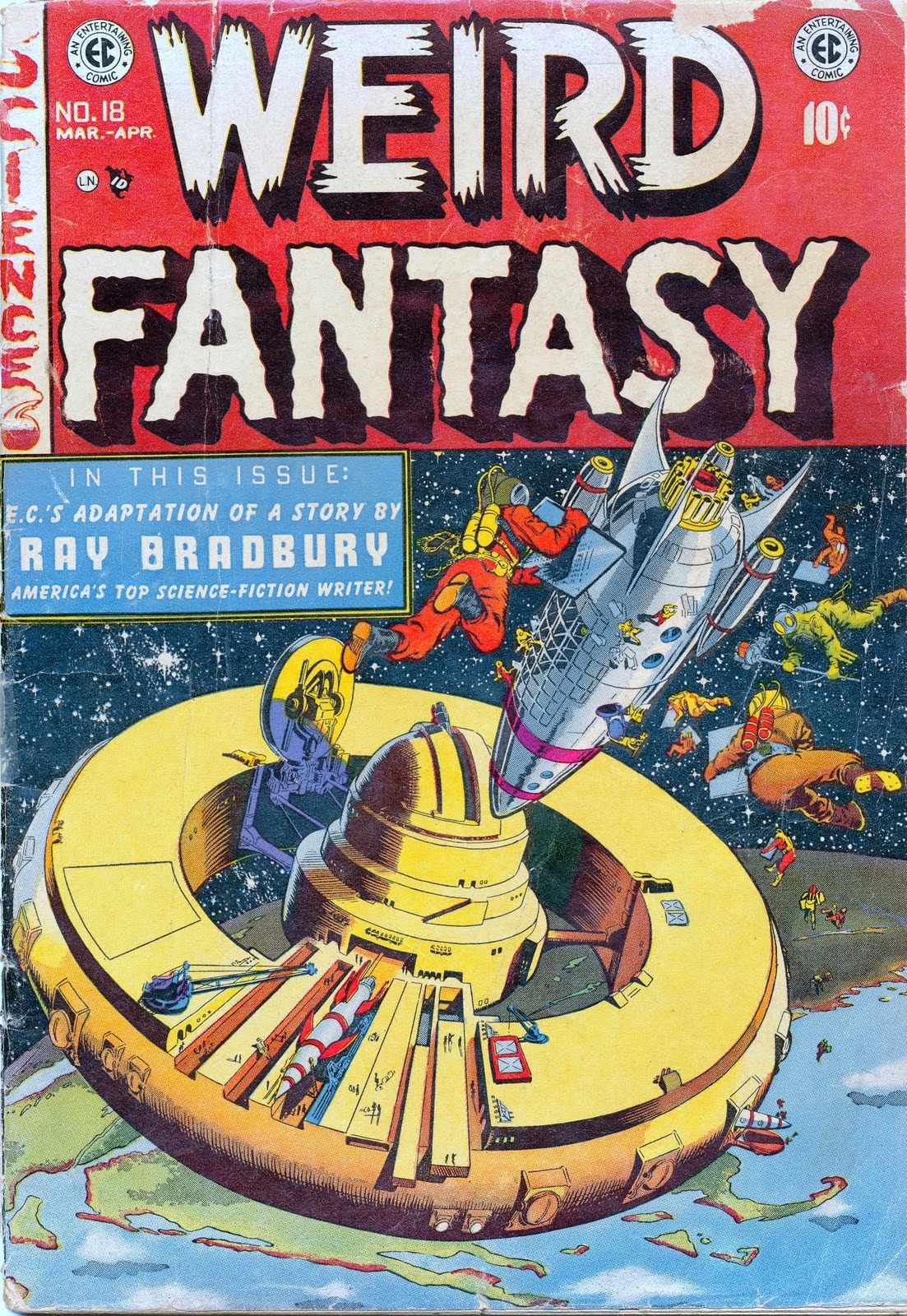
Al Feldstein passed away. Sadly i’m not that familiar with his work, i’ve never read any of those old MAD issues except for a few strips in the Kurtzman artbook and my understanding of EC is largely based on individual artists. I  did get a chance to read his semi infamous strip Judgment Day from Weird Fantasy which can be read here and while time has made it’s ending more and more on the nose it’s publication date being 1956 is pretty amazing.